GSFN's international research and strategic report — a Two-Round International Delphi Consensus study on how global shipping can reach net-zero.
Global Sustainable Futures Network CIC (GSFN) has completed an international research study examining how the global maritime sector can move from ambition to practical, equitable, and scalable decarbonisation.
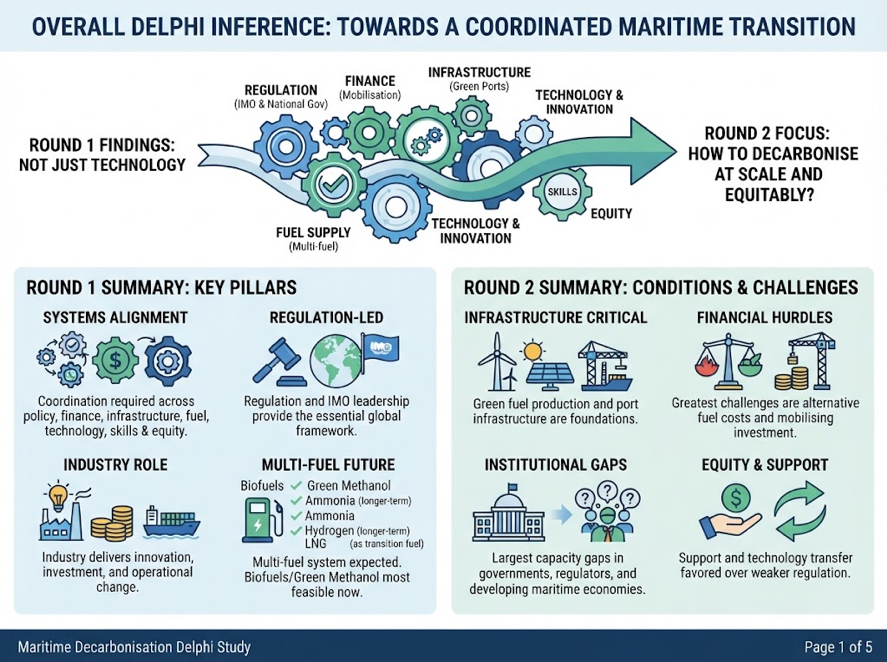
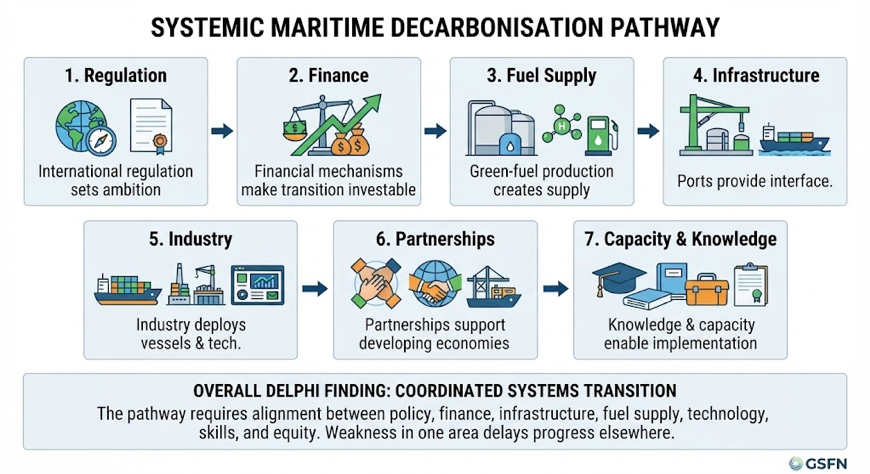
The study brings together international expert perspectives to examine maritime decarbonisation not as a single technology or fuel challenge, but as a complex systems transition. The findings highlight that while net-zero shipping by 2050 is technically achievable, success depends on synchronised development across regulation, finance, fuel production, ports, vessels, and institutional capacity.
Maritime transport is fundamental to global trade, yet its transition to a low-carbon future presents a complex challenge. The sector operates across international jurisdictions and depends upon interconnected systems involving international regulation, national governments, shipowners, ports, fuel producers, financial institutions, and developing maritime economies.
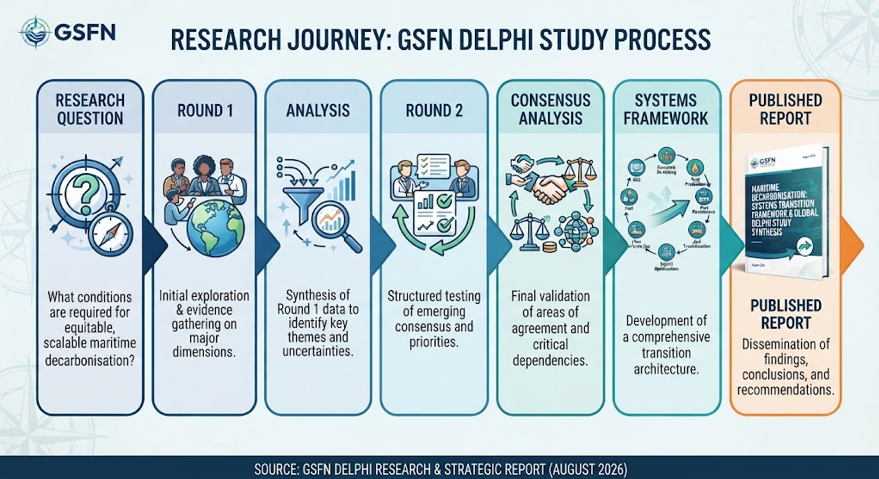
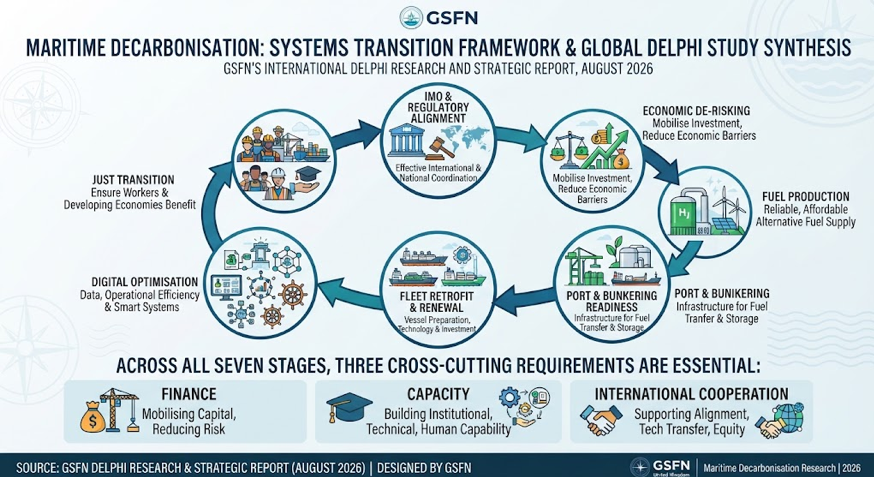
GSFN's research was designed around a central question: what conditions are required for global maritime decarbonisation to happen at sufficient speed, scale, and with greater equity? Rather than assuming one technology or policy mechanism holds the answer, GSFN investigated the interaction between different components of the maritime transition, developing a Systems Transition Framework to understand decarbonisation as an interconnected process.
GSFN used a two-round Delphi methodology to obtain structured expert judgement on this complex issue, drawing on 35 respondents across 13 countries.
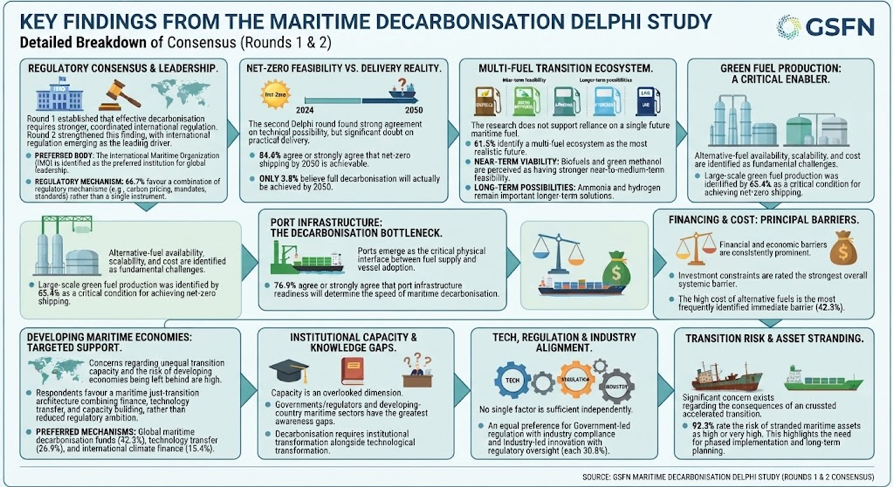
Ten interconnected findings, from regulatory leadership to the risk of leaving developing maritime economies behind.
International regulation is the leading driver. The IMO is the preferred body for global leadership, with 66.7% favouring a combination of regulatory mechanisms over a single instrument.
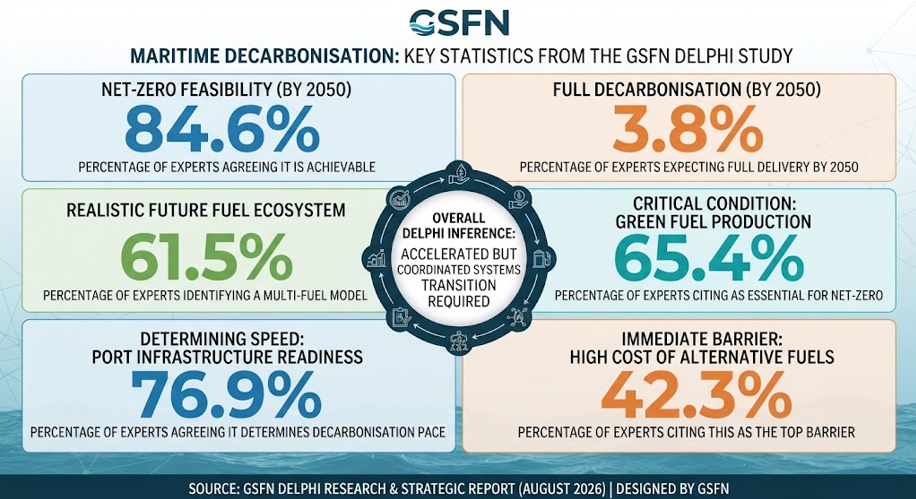
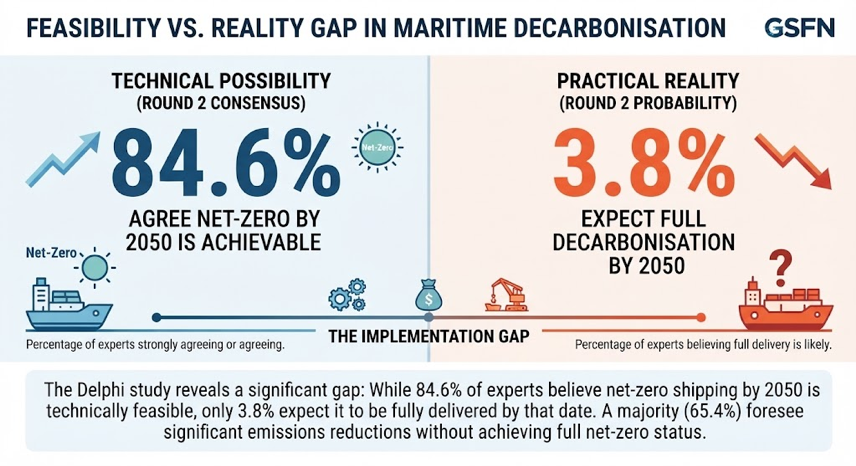
84.6% agree net-zero by 2050 is achievable — but only 3.8% believe it will actually happen by then. Feasibility and probability are not the same thing.
61.5% expect a multi-fuel ecosystem. Biofuels and green methanol lead near-term; ammonia and hydrogen are longer-term pathways. LNG is a bridge fuel, not the answer.
Large-scale green fuel production was identified by 65.4% as a critical condition for achieving net-zero shipping.
76.9% agree port infrastructure readiness will determine the speed of decarbonisation — ports are the critical interface between fuel supply and vessels.
Investment constraints are the strongest systemic barrier. The high cost of alternative fuels is the most frequently cited immediate barrier, at 42.3%.
Respondents favour global maritime decarbonisation funds (42.3%), technology transfer (26.9%), and climate finance (15.4%) — not reduced ambition — to support developing economies.
Governments/regulators and developing-country maritime sectors show the greatest awareness gaps — decarbonisation needs institutional as well as technological transformation.
Government-led regulation with industry compliance, and industry-led innovation with regulatory oversight, tie at 30.8% each — neither works alone.
92.3% rate the risk of stranded maritime assets as high or very high, reinforcing the need for phased, technology-neutral implementation.
Seven interdependent stages, moving from global ambition to fleet-level action.
Establishing an effective international framework.
Creating financial conditions to support investment.
Developing sufficient quantities of alternative fuels.
Ensuring ports can receive and supply fuels.
Preparing vessels for the new fuel mix.
Improving efficiency through data and monitoring.
Ensuring equitable outcomes for workers and economies.
Across all seven stages, three conditions remain essential throughout:
The study moves the discussion from "which fuel will decarbonise shipping?" towards "what regulatory, financial, technological, infrastructural, and institutional conditions must be created for maritime decarbonisation to happen at scale?"
GSFN gratefully acknowledges the time, expertise and thoughtful contributions of all Delphi participants who supported this highly focused research on maritime decarbonisation. Their informed perspectives, critical insights and considered responses have been invaluable in shaping the findings of this study. We deeply appreciate their commitment to engaging with the research process and sharing their knowledge. This report reflects a collective contribution to advancing understanding and practical pathways for maritime decarbonisation.
Lead Organisation: Global Sustainable Futures Network CIC | Collaborating Organisation: Arab Academy for Science, Technology & Maritime Transport, Egypt · Funder: Lloyd's Register Foundation
Published by GSFN CIC, August 2026 · Two-Round International Delphi Consensus · Funded by Lloyd's Register Foundation